Stratos is the flagship project of DARE. Many years of knowledge and research are combined into a single, ambitious project. Stratos V strives to fly DARE’s first-ever cryogenic rocket.
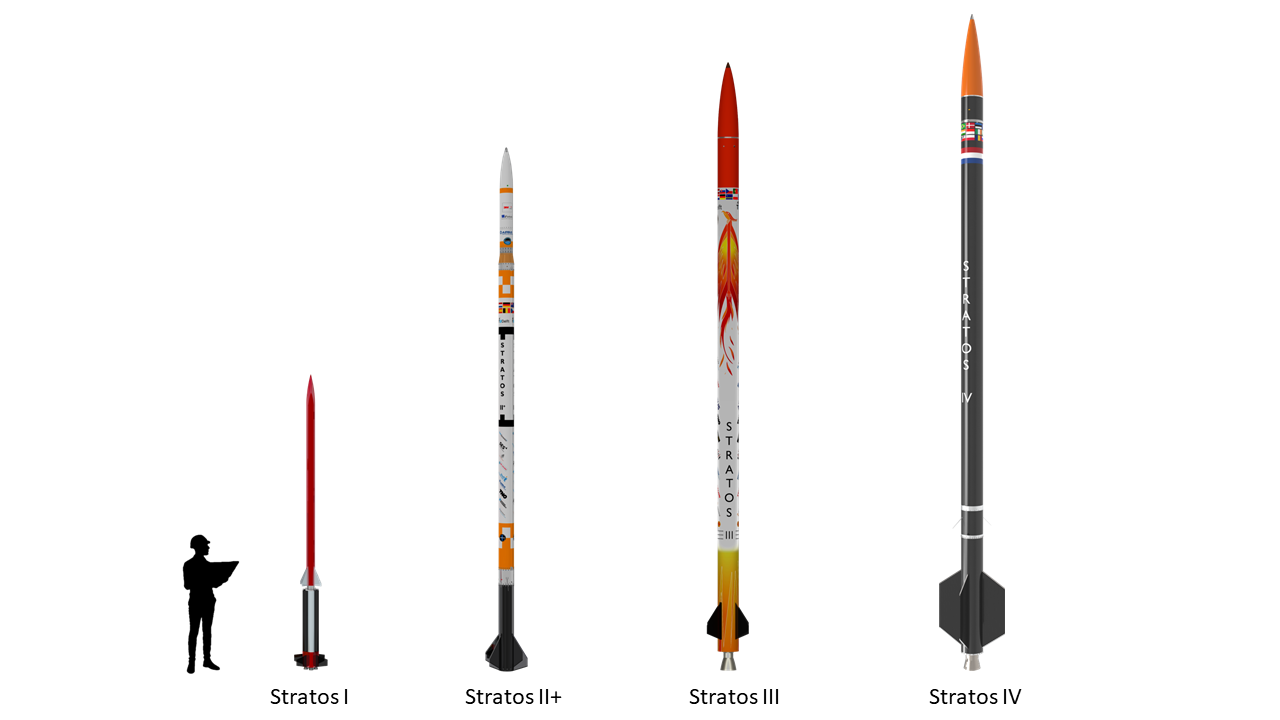
We rely on the knowledge gathered during the four previous Stratos projects. A two-stage solid rocket, Stratos I, was launched in 2009 to an altitude of 12.5 km, setting the European Altitude Record. Stratos II+, a hybrid rocket launched in October 2015, broke our own altitude record at 21.5km. Stratos III was launched in the Summer of 2018, aiming even higher than the last altitude record. Unfortunately, an anomaly occurred 20 seconds after the launch, resulting in the loss of the vehicle. Stratos IV was intended to launch in the Fall of 2021. However, despite our best efforts, ground system difficulties prevented the launch from taking place.
We are currently working on Stratos V and are determined and committed to achieving our new mission:
"Develop a technology demonstrator for a reusable launch vehicle"
All of the components are designed, produced, and tested by us. However, some parts require help from our partners.
Previous slide
Next slide
Previous slide
Next slide
Started in September 2022, the Stratos V rocket is now in its preliminary design phase. An overview of the current specifications is available and will be updated as soon as new changes are made.
Height
6.5 m
21.3 ft
Diameter
28 cm
11 in
Dry Mass
115 kg
254 lb
Propellant Mass
85 kg
187 lb
Average Thrust
9000 N
2023 lbf
max speed
4165 km/h
Mach 3.4
The Mission
Stratos V is, once again, striving to break the boundaries of student rocketry. This time the focus of the mission is on recoverability and reusability. We think these aspects constitute a turning point in today’s rocketry scene. This is mainly due to the cost and environmental advantages gained.
Stratos V is thus planning on completely recovering and launching the rocket a second time.
Additionally, Stratos V will be propelled by the DLX-150 Series “Firebolt” Engine and constitute the first DARE cryogenic liquid bi-propellant rocket.
History of Stratos
The first Stratos rocket was launched from Kiruna, Sweden, in 2009. This two-stage, solid propellant rocket reached an altitude of 12.3km, which at the time set the European altitude record for student rocketry. Stratos II, the successor of Stratos I, was meant to fly even higher than that, but unfortunately, it did not lift off due to a misfire of the engine. This led to a redesign of the rocket, namely Stratos II+. Launched in October 2015 from an INTA facility in Huelva, Spain, Stratos II+ flew to an altitude of 21.5km, breaking our record set by Stratos I.
Recently the record was broken by the Hybrid Engine Development from Stuttgart, Germany, setting it to 32.3km. Consequently, DARE decided to combine the knowledge gained during the Stratos I and Stratos II projects to develop Stratos III, which was designed to go well beyond that boundary and improve the European student altitude record. The rocket was launched on the 26th of July 2018 from INTA in Spain. 20 seconds into the flight, it encountered an anomaly, and the vehicle disintegrated. The Stratos IV team heavily recognized the hard work of their predecessors and decided to build upon it with a new rocket. It was meant to launch in the Fall of 2021, but ground system difficulties prevented the vehicle from taking off. The Stratos team has decided to embrace a new challenge and build the Stratos V rocket!
Project Stratos is carried out under the flag of Delft Aerospace Rocket Engineering, however it falls under the legal responsibility of Stichting Students to Space.